It begins with a golf game.
Two old academic frenemies are out on the links for their annual game. It's a lovely day in May. Dr. Martin Goodman is feeling especially, well, good about the day because at long last he thinks he can finally put the long game of one-upmanship he's had with Dr. Vernon van Dyne to bed: Goodman has just been named the new President of Midtown University. Surely being the leader of MU beats out whatever van Dyne's been working on over at Empire State?
Not so.
Goodman barely gets a chance to boast about his success when van Dyne launches into an enthusiastic account of the discoveries a member of his faculty, a Dr. Hank Pym, has made. Goodman, who has always been aware that he's not a good a scientist as van Dyne (but a much better bureaucrat and politician), barely listens to his golf partner's description of particles and claims that Pym's discovery will alter the course of mankind. He just stews, knowing that such a leap forward will put Empire on the map and blow the achievements of Midtown University's science department, the department he built by the way, out of the water.
So after losing the golf game and choking down a few highballs in the clubhouse that taste of poison and failure, Goodman rushes back to campus, bursts into the labs, and corners the first promising young idea man he can find.
Reed Richards.
Richards is an interesting choice for Goodman, but the older man rarely thinks things through and just tends to go with his gut. Sure, Richards had that 'incident' with a dorm mate last year that lead to that other fellow dropping out and heading back to Eastern Europe, but he's a bright kid - eager, intelligent, and best of all for Goodman's purposes, naive. In his riled up state, Goodman doesn't really explain what Pym is working on, instead he just focuses on what he wants out of Richards - something big, something life changing
Something fantastic.
In return, Richards can have all the funding he wants. Doctorate? No problem. Whatever you build will be your dissertation. If it works, you have your PhD. If it works well, works big? You have a job with tenure. Whatever you need, whatever you want, just make... something.
That's the sort of blank check that a young scientist like Reed Richards can't ignore. Given free run of the science facilities, he dives into his work. He's not sure exactly what he'll work on, but who cares? There's an entire universe of possibilities out there. Hrm. Universe. Now there's an idea. Let's go see the universe.
Early on, Reed decides to skip the Moon. It's just a dead rock, right? People have been watching it for centuries and it hasn't done anything of interest. No, Reed wants to make a ship that can go anywhere, a sort of phasic ship that can skim the cosmic radiation of the universe and go anywhere almost instantly. He gives his list of requirements to Goodman who wastes no time in pulling resources from other parts of the university to support Richards. Sorry, Dr. Octavius, but we need your nuclear power core. No, Doctor, technically it's university property and if you don't like it, you can leave. Okay, bye, don't let the door hit you on the way out.
Richards works on into the summer. He builds a Cosmic Beacon, a way for his ship to find its way home from the outer fringes, and even has a bit of a mental breakdown. When Goodman learns that all his eggs are currently in a basket that might be warping under the pressure, he brings in the daughter of an old friend of his, Dr. Franklin Storm. Frank fell on some rough times and Sue could use the work to help support herself and her brother.
Turns out, bringing in Sue Storm as Richard's assistant was a masterstroke of management. Reed's behavior calms down - he even stops claiming to have been visited by extra-terrestrials when he first turned on the Cosmic Beacon - and he's able to refocus on his work. Sue proved adept at managing Reed's attentions, knowing when to kick him out of the lab and make him spend time his his friends and when to let him work through the night. The two become close and fall in love.
Sue is the one that notices signs of Reed starting to crack again, but this time it's not because of his work. His best (only) friend, Ben Grimm, joined the Air Force some time ago and it looks like he's about to be deployed in an 'advisory capacity' in the recently turbulent theatre Vietnam. She's the one who goes to Goodman and suggests that the young pilot is someone that Project Fantastic needs, not only to fly the ship, but to keep Richards on an even keel.
Ben Grimm, who was Richard's roommate in undergrad, is a bit put out that he's missed an opportunity to help his country, but in the end he comes around. He actually proves to be really helpful - having spent enough time in a cockpit, he knows what a pilot needs. As Sue gets more and more involved in the project, her brother Johnny steps in as well. Just as Reed needs Sue to keep him grounded, Sue needs Johnny. Besides, Goodman pulled the strings that are paying for Johnny's college education, so helping out at the Midtown University labs is really just some sort of workstudy job, right?
Of course, this sort of thing can only go on so long before the University's Board of Trustees start sniffing around. Where is all this money going? Why are tenured members of faculty complaining that their resources are being usurped by a 24 year old? In October of 1961, the Board steps in and puts a halt to Richard's work. At first, Goodman fights them on it - just look at what the kid has done in a few months! A Cosmic Beacon! Sure, it doesn't seem to do anything practical for the moment, but in time it will put humanity's stamp on the universe! Just a little more time!
But then Vernon van Dyne dies under suspicious circumstances and the fight goes out of Goodman. What's the point if the one person he wanted to show up is gone? Maybe the Board is right. Throttle down the crazy pace. Yes, yes, Richards, you can still work on it. Here, you can even have your doctorate like I promised. The university simply can't commit unlimited resources to Project Fantastic any more. Your ship will still fly, just not for another decade or so. I don't care if you are so close. We need to wind things down by the end of November.
Reed Richards, having grown used to his frantic research pace, is not ready to slow down. How many years will be lost while the University seeks to partner with other institutions? How will the project change if the government gets involved? With the project wound down, Ben will have to go back to Vietnam...
No. Ef that. We'll go into space. We'll see the universe. And we'll do it soon.
So it's over the long Thanksgiving weekend that Reed, Sue, Johnny, and Ben slip into the lab and ready the ship. The Beacon is activated and the ship launches, phasing up and out through solid matter, up into the sky, out into the great unknown. The four succeed. They see the universe! Everything! Stars and galaxies and... life? Is that really signs of life they see? It's hard to tell, phasic travel is so confusing. It's like you're everywhere at once with only the Beacon to keep you grounded, to give you a sense of up and down, of here and there.
And then someone shuts it off. It's not really Stanley Lieber's fault. He's just a guy working a night custodian job to earn some money until his writing career takes off. He just walked into the lab, saw it empty with all the lights on and machinery humming, and shut it down, whistling, before moving down the hall.
Without the Cosmic Beacon, the four travelers are in crisis. Currently, they're Everywhere. How can they get back to There without the Beacon? It's a close run thing. It takes all of them working together to guide the ship through extra dimensional space back home. Without the Beacon, they take the Long Way Home, passing through the very edge of creation itself.
That the craft crash lands in Upstate New York is a testament to Ben Grimm's piloting skills. Imagine threading a needle with a pin from ten feet away while drunk and dizzy. To even hit the needle with the thrown pin would be amazing, and that's just the equivalent of the four finding their way back to our solar system.
We all know what happens when the four emerge from the craft. They've changed. Rocky features, flaming skin, invisible body, elastic form. But still, they're alive, the four of them and they've returned from a fantastic voyage.
And the world will never be the same.

Thursday, March 28, 2013

Tuesday, March 26, 2013
Marvel Pre-History
So one aspect of the Marvel reboot I've decided on is that I'll be starting Year 0 as Year 1961. This is, of course, the year Fantastic Four #1 came out. It's also the year the words 'Marvel Comics' first appeared on the newstands, but I think you can forgive me for not starting my version of the Marvel Universe with Patsy Walker.
Of course, by starting in 1961 that leaves a lot of Marvel canon languishing in the past. All of the Golden Age and World War 2 stuff, for example, would have already happened before I even get to Year 0. While Marvel (then Timely) didn't have a huge Golden Age when compared to DC, they did have several heroes that came out pre-Fantastic Four. Most of them were relegated to the ash heap of history, occasionally brought out when Marvel is in a nostalgic mood, heroes like Captain America, Namor, and maybe even the original Human Torch, need to be acknowledged.
It's also interesting to note that Sgt. Nick Fury (and his Howling Commandos), though active in WWII, did not come out in comicbook form until 1963. I guess this shows how DC I am when I had sort of assumed that Fury was active in comics in WWII in some form before being brought back in the Silver Age as a super-spy S.H.I.E.L.D. agent. Speaking of S.H.I.E.L.D., HYDRA predates them by a few years, having been introduced in the 50s in Menace doing typically HYDRA things (stealing a bomb that turns people into monsters). Red Skull was from the 40s.
Out of all that mess, we need to do some clean up. If the characters listed above, only Captain America has any real need to be tied into the past. Nick Fury can howl his way across Korea in the early 50s, which leaves him plenty of background before he becomes a spy in 1965. Captain America, though, is just too iconic for his Nazi-punching to be shifted up to the Korean War. Even though they were part of the Invaders, Namor and the Human Torch don't really have the same Golden Age legacy - they came into their own through the lens of the Fantastic Four in the 60s.
So here's the deal: Captain America, Bucky, Red Skull, and all that happened back in WWII. Cap totally punched Hitler in March of 1941, which lead to Hitler authorizing the funding Johann Schmidt wanted for his own superscience programs. He figured that even if they couldn't come up with a counter to Captain America, they certainly could distract the guy with an endless parade of wacky schemes. One of those schemes went awry, which is why Schmidt's got a bit red in the face. Captain America (and Bucky) went missing soon after defeating the Red Skull in 1945 - there was a big explosion at a Nazi base, but eyewitness reports were conflicted. Maybe it was a rocket being launched from the base that the GIs saw, maybe it was just debris.
Namor might have been active during WWII, but if he was, he was just defending his undersea kingdom from German U-boats. No big team ups with him and Cap and the Human Torch (who despite his legacy as being the oldest of the Timely superheroes, I'm sadly confining to the scrap-bin of history - the first Torch anyone cares about will be Johnny Storm).
Red Skull's Sleepers are still active through out the 50s. These are little surprises he put in place when it looked like his beloved Reich would fall. The Sleepers, robots and bombs and so on, could account for the large number of "alien visitors" that appeared in the 50s. Maybe Schmidt knew something the rest of the world didn't? I've always liked the idea that HYDRA isn't just about recapturing the power of the Reich, but instead trying to rebuild and recollect some of the power of the organization's early days. Future leaders Strucker and Zemo know full well that they are living in the Skull's shadow and are agog at the amount of innovations that came out during his leadership (Hint: Step 1 - Create Time Dilation Technology). More on HYDRA to come!
So what about the rest of the Marvel Universe? I've decided that I won't worry about it much until I need to. While I'd love to flashback thousands of years to the creation of the Eternals, the Inhumans, and hell, according to Marvel Saga even Conan is part of the continuity, I'll deal with them when their characters actually step up onto the world stage. Otherwise, I may never get this thing off the ground! In between Chronology entries, I'll do separate ones covering the backstories of some of the setting elements that had just become relevant. No need to go into Asgardian history until it starts to matter with Thor's first appearance in 1962.
Crap, that's coming up soon, huh?
Of course, by starting in 1961 that leaves a lot of Marvel canon languishing in the past. All of the Golden Age and World War 2 stuff, for example, would have already happened before I even get to Year 0. While Marvel (then Timely) didn't have a huge Golden Age when compared to DC, they did have several heroes that came out pre-Fantastic Four. Most of them were relegated to the ash heap of history, occasionally brought out when Marvel is in a nostalgic mood, heroes like Captain America, Namor, and maybe even the original Human Torch, need to be acknowledged.
It's also interesting to note that Sgt. Nick Fury (and his Howling Commandos), though active in WWII, did not come out in comicbook form until 1963. I guess this shows how DC I am when I had sort of assumed that Fury was active in comics in WWII in some form before being brought back in the Silver Age as a super-spy S.H.I.E.L.D. agent. Speaking of S.H.I.E.L.D., HYDRA predates them by a few years, having been introduced in the 50s in Menace doing typically HYDRA things (stealing a bomb that turns people into monsters). Red Skull was from the 40s.
Out of all that mess, we need to do some clean up. If the characters listed above, only Captain America has any real need to be tied into the past. Nick Fury can howl his way across Korea in the early 50s, which leaves him plenty of background before he becomes a spy in 1965. Captain America, though, is just too iconic for his Nazi-punching to be shifted up to the Korean War. Even though they were part of the Invaders, Namor and the Human Torch don't really have the same Golden Age legacy - they came into their own through the lens of the Fantastic Four in the 60s.
So here's the deal: Captain America, Bucky, Red Skull, and all that happened back in WWII. Cap totally punched Hitler in March of 1941, which lead to Hitler authorizing the funding Johann Schmidt wanted for his own superscience programs. He figured that even if they couldn't come up with a counter to Captain America, they certainly could distract the guy with an endless parade of wacky schemes. One of those schemes went awry, which is why Schmidt's got a bit red in the face. Captain America (and Bucky) went missing soon after defeating the Red Skull in 1945 - there was a big explosion at a Nazi base, but eyewitness reports were conflicted. Maybe it was a rocket being launched from the base that the GIs saw, maybe it was just debris.
Namor might have been active during WWII, but if he was, he was just defending his undersea kingdom from German U-boats. No big team ups with him and Cap and the Human Torch (who despite his legacy as being the oldest of the Timely superheroes, I'm sadly confining to the scrap-bin of history - the first Torch anyone cares about will be Johnny Storm).
Red Skull's Sleepers are still active through out the 50s. These are little surprises he put in place when it looked like his beloved Reich would fall. The Sleepers, robots and bombs and so on, could account for the large number of "alien visitors" that appeared in the 50s. Maybe Schmidt knew something the rest of the world didn't? I've always liked the idea that HYDRA isn't just about recapturing the power of the Reich, but instead trying to rebuild and recollect some of the power of the organization's early days. Future leaders Strucker and Zemo know full well that they are living in the Skull's shadow and are agog at the amount of innovations that came out during his leadership (Hint: Step 1 - Create Time Dilation Technology). More on HYDRA to come!
So what about the rest of the Marvel Universe? I've decided that I won't worry about it much until I need to. While I'd love to flashback thousands of years to the creation of the Eternals, the Inhumans, and hell, according to Marvel Saga even Conan is part of the continuity, I'll deal with them when their characters actually step up onto the world stage. Otherwise, I may never get this thing off the ground! In between Chronology entries, I'll do separate ones covering the backstories of some of the setting elements that had just become relevant. No need to go into Asgardian history until it starts to matter with Thor's first appearance in 1962.
Crap, that's coming up soon, huh?
Wednesday, March 20, 2013
The Age of Drewatu
GREETINGS, MORTAL!
I AM DREWATU THE WATCHER!
I SHALL TELL THE TALE OF AN AGE OF MARVELS
Ahem. Sorry about that. So, yeah, I'm getting ready to embark on the long promised reboot of the Marvel Universe. Finally after long years I will justify my scribbling a beard on Fing Fang Foom, Elektra, and Cyclops in the banner above.
In doing research for this project (subscribing to Marvel Unlimited, digging up my tattered Essential Marvel Saga, etc), I'm starting to get a grasp on the sheer scope of what lies ahead. This looks like it will be much harder than the DC Reboot for a few reasons.
First, I'm not writing to a list of titles. The framework of the 52 allowed me the armature to mold the clay around. I knew I had limited space (52 titles) and certain requirements (# of Bat-books >5) which weirdly gave me more freedom to tweak the setting. No disappearing down a rabbithole of the history of Thanagar or the origins of the Lazarus Pits. I mean, I did do that, but not in any of my blog entries.
Second, the approach I want to take is difficult. I mean, basically what I want to do is come up with the story of the Marvel Universe if Marvel Time did not exist. Obviously, taking a concept named after the setting from the setting is not easy. Marvel Time, that sort of fuzzy flux around the Marvel universe where things happened 'a few years ago' rather than 'in 1962' is a core part of the setting. That's why Marvel avoids all the reboots good ole DC goes through - because characters don't really age and history compacts itself to fit a given timeframe. Look at Spidey, for example, the dude (or his body at least) is currently, what, in his early 20s? Yet he's had how many adventures? How many experiences? Surely much more than could fit into the 7 or 8 years he's been Spider-Man (and that's even accounting for those experiences Brand New Day'd away by the Devil). To pin down events to a given year then move forward would unwind the tapestry holding everything together. If Spider-Man got his powers at the age of 15 in 1962, he'd be 66 today.
Third, the scope of the Marvel Universe is bugnuts insane. Villains range from dudes who use stilts to steal things from second story windows all the way up to godlike aliens who eat planets. Same thing for heroes - you have guys who are good with a bow standing next to gods of myth and thunder. DC gets some of this too, but you never get the same sense that some characters are simply out of their league in a given situation. Call it the Batman Effect, but in DC, any mortal with a certain level of training has a chance to defeat a cosmic conqueror. Maybe their chances are not as good as their pal who just happens to be the Last Son of Krypton, but they're not bad. You can see the Batman Effect play out semi-weekly in Young Justice, a show on the Cartoon Network based around the idea that the overlooked sidekicks are actually the most dangerous heroes. Hell, after catching up on that show over this past snowy winter, it's pretty clear that the most dangerous members of the Young Justice setting are the humans - Artemis, Robin, Sportsmaster, Cheshire, etc (and that's before to even get to Normal People in Power Suits). The closest thing Marvel has to the Batman Effect is Squirrel Girl and her ability to bring down baddies several magnitudes bigger than her is played like a schtick, the exception that proves the rule.
Fourth, the higher up you climb on the Marvel Power Ladder, the more insane things get. Galactus. Celestials. The Living Tribunal. Mephisto. The Elders of the Universe. Beyonders. Eon. The Asgardians. Even Death plays a part. You also have a heaping Celestial-sized handful of super-powerful MacGuffins like the Ultimate Nulifier, Cosmic Cubes, Soul Gems, Infinity Gauntlet, and probably dozens more pieces of junk that were Items of the Week in the 1960s. Getting all these cosmic powers to work together in a logical way has been the work of Marvel writers for decades. While DC spun its wheels in the Silver Age, Marvel kept ramping up the dangers. I mean, Galactus first appeared in 1966. The Living Tribunal in '67. If we keep plotting that trajectory, where the hell are we going to be in 2013?
Still, this looks like it will be a fun project. Marvel's roots are in sci-fi and there's much more of a sense that anything can happen (minor villain constructs a copy of Earth on the other side of the sun? Why not.), a sense that will be magnified once we get to a place where the classic Marvel heroes of yore start to age out of the business. Peter Parker will need to hang up his webslingers at some point, so Ben Reilly will get his chance, ultimately passing the torch to Miles Morales in the modern age.
I know nobody will really see it outside of random mentions on discussion boards (Hi, Space Battles!), but I didn't spend all those years reading Marvel Comics and not learn a little something about courage. But if you did happen to stumble on this site while googling (and I've seen the search terms that bring people here *shiver*), please stick around and enjoy
THE MARVEL AGE OF DREW!
Wednesday, March 13, 2013
Toddler Reboot: Fireman Sam
So I may have mentioned that I'm a dad. My son is only 2.5 years old, so he's still way to young for comics. I tried (when Mom wasn't looking) to get him started on Marvel's Super Hero Squad, but he didn't take too kindly to Fing Fang Foom or the Hulk. Maybe when he's a bit older. At the very least, he now calls the Jolly Green Giant the Hulk, so the foot is in the door.
He loves cartoons, though, and one cartoon in particular: Fireman Sam. It's set in the Welsh village of Pontypandy and everyone there is suicidal. This probably explains why there are only like eight people in the entire place (despite seeing row after row of houses) - the rest of the population succeeded in offing themselves and those that remain are just too dim to get the job done.
Not for lack of trying, mind you. Norman Price, the red headed son of the owner of the local market, endangers his life and others on a routine basis. He's always getting stuck on top of things (cliffs, towers), in things (fences, burning rooms), on things (doorknobs in said rooms), or at the bottom of things (wells). There's the town handyman, Mike Flood who is pretty clumsy and falls down pits or ends up dangling from roofs with a frequency that's even more disturbing when you consider his love of fireworks and rocketry. There's also a fisherman who gets stranded at sea, a sidekick firefighter who explodes ovens, a bus driver who really needs to pay better attention to the maintenance of his bus, and a handful of kids who just love to hide in underwater caves, under crates, or in burning buildings. Fireman Sam is called upon to rescue them all.
So what I'm saying is, it's a grim place. You think the writers of the show would have run out of emergencies by now, but Sam is actually in its second iteration. The original show was all claymation animated (and was originally all in Welsh) and the new version (the one my son loves) is computer animated.
Which leads me to my reboot, or at very least, my attempt to explain what the hell is going on.
Fireman Sam is dead. He is in Purgatory. The limited cast of characters that populate his limbo are the souls of those he could not rescue. Sam died in the transition between stopmotion animated and computer animation. This explains why the stereotypical Italian restaurant owner is now longer around - as a good Catholic, she ascended to Heaven.
Sam does not realize he is dead. He just goes through the same motions day after day. He will be free when he admits his failures, his sins, and his own death. There is an angel present - Charlie the Fisherman (get it!?). In the show, he's Sam's brother, a brother that was never mentioned in the show's initial run. That he is family in the Purgatory version is important as one of Sam's greatest sins is his refusal to acknowledge his own son, the only other ginger in town, Norman Price.
Norman has no stated dad and his mom, Dilys, has shown herself to be rather forward in her conquest of new lovers (Trevor the Bus Driver). So I imagine on some lonely night, perhaps while Sam was new in town, he and Dilys got it on. Dilys was blackmailing Sam - why else would she insist on calling him over every little thing? All those random visits were not just to "check the smoke detector," there was money exchanged. So when The Great Fire came, Sam took his chance and let Dilys burn. Unfortunately, he let the rest of the town burn as well.
So until he admits what he did, he's trapped, doomed to endlessly rescue the same crew of suicidal shades (they yearn to be free as well) from the hell of his own creation.
I sympathize with Fireman Sam, because until my toddler finds a new obsession, I'm damned as well - doomed to endlessly watch Fireman Sam endlessly rescue the same crew of suicidals.
He loves cartoons, though, and one cartoon in particular: Fireman Sam. It's set in the Welsh village of Pontypandy and everyone there is suicidal. This probably explains why there are only like eight people in the entire place (despite seeing row after row of houses) - the rest of the population succeeded in offing themselves and those that remain are just too dim to get the job done.
Not for lack of trying, mind you. Norman Price, the red headed son of the owner of the local market, endangers his life and others on a routine basis. He's always getting stuck on top of things (cliffs, towers), in things (fences, burning rooms), on things (doorknobs in said rooms), or at the bottom of things (wells). There's the town handyman, Mike Flood who is pretty clumsy and falls down pits or ends up dangling from roofs with a frequency that's even more disturbing when you consider his love of fireworks and rocketry. There's also a fisherman who gets stranded at sea, a sidekick firefighter who explodes ovens, a bus driver who really needs to pay better attention to the maintenance of his bus, and a handful of kids who just love to hide in underwater caves, under crates, or in burning buildings. Fireman Sam is called upon to rescue them all.
So what I'm saying is, it's a grim place. You think the writers of the show would have run out of emergencies by now, but Sam is actually in its second iteration. The original show was all claymation animated (and was originally all in Welsh) and the new version (the one my son loves) is computer animated.
Which leads me to my reboot, or at very least, my attempt to explain what the hell is going on.
Fireman Sam is dead. He is in Purgatory. The limited cast of characters that populate his limbo are the souls of those he could not rescue. Sam died in the transition between stopmotion animated and computer animation. This explains why the stereotypical Italian restaurant owner is now longer around - as a good Catholic, she ascended to Heaven.
Sam does not realize he is dead. He just goes through the same motions day after day. He will be free when he admits his failures, his sins, and his own death. There is an angel present - Charlie the Fisherman (get it!?). In the show, he's Sam's brother, a brother that was never mentioned in the show's initial run. That he is family in the Purgatory version is important as one of Sam's greatest sins is his refusal to acknowledge his own son, the only other ginger in town, Norman Price.
Norman has no stated dad and his mom, Dilys, has shown herself to be rather forward in her conquest of new lovers (Trevor the Bus Driver). So I imagine on some lonely night, perhaps while Sam was new in town, he and Dilys got it on. Dilys was blackmailing Sam - why else would she insist on calling him over every little thing? All those random visits were not just to "check the smoke detector," there was money exchanged. So when The Great Fire came, Sam took his chance and let Dilys burn. Unfortunately, he let the rest of the town burn as well.
So until he admits what he did, he's trapped, doomed to endlessly rescue the same crew of suicidal shades (they yearn to be free as well) from the hell of his own creation.
I sympathize with Fireman Sam, because until my toddler finds a new obsession, I'm damned as well - doomed to endlessly watch Fireman Sam endlessly rescue the same crew of suicidals.
Wednesday, March 6, 2013
What If Superman Were Gay?
Like most people who lurk on the fringes of the comics world, I've been following the whole Orson Scott Card Writes Superman debacle for a few weeks now. I'm not sure if anything else needs to be said about it beyond the broad strokes - famous author who actively campaigns to withhold the rights of others gets opportunity to write beloved character, fans of beloved character who (like the character himself) want equal rights for all get mad and promise to withhold support. DC is tone deaf on the issue which causes more consternation leading to the original artist who was paired with controversial author to bow out, delaying the whole comic.
Outside of wanting two people who love each other to be able to legally bind their lives together and not have to worry about being denied visiting their loved ones in a hospital, I don't have much of a horse in this race. I mean, the last time Card wrote comic story featuring a pre-existing character, he turned Iron Man into a big blue brain slug that was just shaped like a person.
Yeah, pass.
But it did get me thinking about what would happen if Superman was gay? This line of thought distracted me for all of ten seconds on the train ride in this morning because, well, it wouldn't change much. Would Superman still rescue people? Yes. Would he still fight intergalactic badguys? Sure. He'd be pretty much the same hero he always was, only instead of smooching Lois, he'd smooch Jimmy.
Hell (H'eL?), you wouldn't even need to change much of his backstory. I mean, he's a person with a secret who grew up in a conservative farm town in Kansas. In Superman's case, that secret is that he's an alien. For a lot of people, that secret is that they are gay, bi, or transgender and feel that they are unable to admit it due to societal pressures. Compared to being an alien, being gay is so far down the list of Things Clark Needs to Worry About (below 'Pa Needs To Watch His Cholesterol,' above 'Warranty on the Tractor is Running Out in Two Years') that he'd probably be out by his senior year just to get Lana off his back.
Would we see a change in Superman's behavior? Maybe. It'd be hard for him to be more of a champion for equality, but then again he is an immigrant and I don't recall him speaking up on those issues as well. He might have been distracted by all the alien-punching, plane catching, and Luthor-thwarting he does.
Because Superman's sexuality is rarely at the forefront, it really doesn't matter where on the Kinsey scale he falls. It's just not important to the character or the stories he appears in. He'd still appear to be the same hero he is now.
I wonder, though, if the same could be said about changing Superman's ethnic appearance or gender? In those cases, you'd have a hero who would physically appear different than what we have now. We'd still have the Kents' upbringing guiding the hero's behavior, giving him/her a sense of right and wrong. The character would do the same things - fight Mogul, throw missiles into the sun, jump tall buildings - and would probably be treated much the same in the world of the comic. Given that the majority of people are okay with a big green guy from Mars flying around, I'm pretty sure they could take a darker skinned Superman. They have no problem with Wonder Woman, so I'm sure Superwoman would get a pass too. In the setting, Superman is Superman is Superwoman is Superman.
No, the big change would come from how the creators and the readers would treat this Alternate Superman. Think about how Wonder Woman is drawn. Think about all the lazy stereotypes applied to minorities in comics. Could the current comics industry pull off a Superman who isn't a white dude?
Outside of wanting two people who love each other to be able to legally bind their lives together and not have to worry about being denied visiting their loved ones in a hospital, I don't have much of a horse in this race. I mean, the last time Card wrote comic story featuring a pre-existing character, he turned Iron Man into a big blue brain slug that was just shaped like a person.
Yeah, pass.
But it did get me thinking about what would happen if Superman was gay? This line of thought distracted me for all of ten seconds on the train ride in this morning because, well, it wouldn't change much. Would Superman still rescue people? Yes. Would he still fight intergalactic badguys? Sure. He'd be pretty much the same hero he always was, only instead of smooching Lois, he'd smooch Jimmy.
Hell (H'eL?), you wouldn't even need to change much of his backstory. I mean, he's a person with a secret who grew up in a conservative farm town in Kansas. In Superman's case, that secret is that he's an alien. For a lot of people, that secret is that they are gay, bi, or transgender and feel that they are unable to admit it due to societal pressures. Compared to being an alien, being gay is so far down the list of Things Clark Needs to Worry About (below 'Pa Needs To Watch His Cholesterol,' above 'Warranty on the Tractor is Running Out in Two Years') that he'd probably be out by his senior year just to get Lana off his back.
Would we see a change in Superman's behavior? Maybe. It'd be hard for him to be more of a champion for equality, but then again he is an immigrant and I don't recall him speaking up on those issues as well. He might have been distracted by all the alien-punching, plane catching, and Luthor-thwarting he does.
Because Superman's sexuality is rarely at the forefront, it really doesn't matter where on the Kinsey scale he falls. It's just not important to the character or the stories he appears in. He'd still appear to be the same hero he is now.
I wonder, though, if the same could be said about changing Superman's ethnic appearance or gender? In those cases, you'd have a hero who would physically appear different than what we have now. We'd still have the Kents' upbringing guiding the hero's behavior, giving him/her a sense of right and wrong. The character would do the same things - fight Mogul, throw missiles into the sun, jump tall buildings - and would probably be treated much the same in the world of the comic. Given that the majority of people are okay with a big green guy from Mars flying around, I'm pretty sure they could take a darker skinned Superman. They have no problem with Wonder Woman, so I'm sure Superwoman would get a pass too. In the setting, Superman is Superman is Superwoman is Superman.
No, the big change would come from how the creators and the readers would treat this Alternate Superman. Think about how Wonder Woman is drawn. Think about all the lazy stereotypes applied to minorities in comics. Could the current comics industry pull off a Superman who isn't a white dude?
Tuesday, March 5, 2013
Yearly Check In
I should really keep up on this blog. I'm reading comics again (but nothing from the New 52) and even will be going to Comic-Con this summer.
My consumption of comics has changed over the year - mostly iPad based ComiXology binges. I still make sure to buy Adventure Time single issues from the Favorite Local, but have started to falter on picking up trades, mainly because I can't remember where I am in a given series.
I listen to a few comic podcasts as well - House to Astonish and Wait, What? mainly. I tried some others, but they didn't stick. I'm not sure why - W,W? is essentially two hours of rambling, but it's two hours I like for some reason. Looking over my podcast pull-list, I see a trend for favoring podcasts featuring "friends with accents who are enthusiastic about a topic" so I guess my fondness rests solely on Graeme McMillan's cheery shoulders.
Anyways, I was pondering doing a Living Marvel Universe type thing where I move through Marvel history and actually have characters age and die and so on, but I realized I'd be stuck when I finished the Bronze Age. Are there any new Marvel characters after, say, 1995? If so, would they be compelling without the Old Classics still kicking around?
My consumption of comics has changed over the year - mostly iPad based ComiXology binges. I still make sure to buy Adventure Time single issues from the Favorite Local, but have started to falter on picking up trades, mainly because I can't remember where I am in a given series.
I listen to a few comic podcasts as well - House to Astonish and Wait, What? mainly. I tried some others, but they didn't stick. I'm not sure why - W,W? is essentially two hours of rambling, but it's two hours I like for some reason. Looking over my podcast pull-list, I see a trend for favoring podcasts featuring "friends with accents who are enthusiastic about a topic" so I guess my fondness rests solely on Graeme McMillan's cheery shoulders.
Anyways, I was pondering doing a Living Marvel Universe type thing where I move through Marvel history and actually have characters age and die and so on, but I realized I'd be stuck when I finished the Bronze Age. Are there any new Marvel characters after, say, 1995? If so, would they be compelling without the Old Classics still kicking around?
Thursday, February 9, 2012
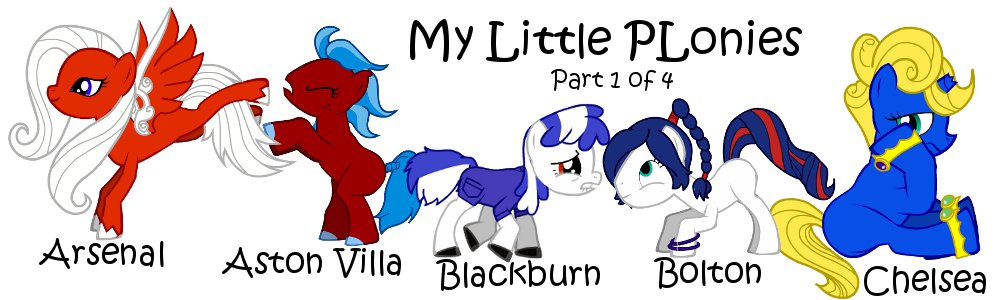
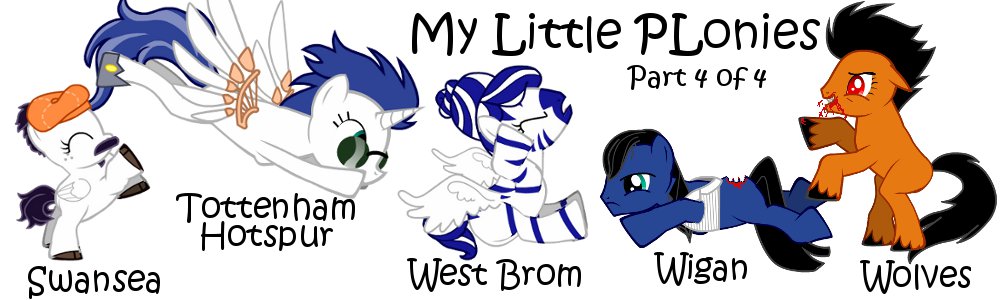
My Little PLony
Yeah, yeah, long time, no post. Between the academic semester resuming and my preference for trades over single issues, I've not had much to say about comics.
So instead, here's a digression involving English Premier League Teams and My Little Pony!


So instead, here's a digression involving English Premier League Teams and My Little Pony!


Subscribe to:
Posts (Atom)